Note: The erosivity methodology is based on Wischmeier & Smith (1978), Renard et al. (1997), and DIN 19708:2017-08. The kinetic energy formula defaults to Rogler & Schwertmann (1981), with Brown & Foster (1987) and McGregor et al. (1995) also available. I developed this package as part of my PhD research at the University of Padova.
About
pyErosivity is a Python package for computing rainfall erosivity (R-factor / EI30) from precipitation time series at any temporal resolution. Erosivity quantifies the capacity of rain to detach and transport soil — a key driver in the USLE/RUSLE family of soil erosion models. The package handles the full pipeline from raw precipitation data to per-event and annual erosivity statistics, including temporal resolution correction and bootstrap uncertainty estimation.
Pipeline
The standard call order is:
remove_incomplete_years()— removes years exceeding the missing-data tolerance; returns cleaned DataFrame and detected time resolution.get_events()— separates storms by a minimum dry-spell gap (default 6 hours, Wischmeier & Smith 1958).remove_short()— discards events shorter than a minimum duration.get_events_values()— for each event computes depth, kinetic energy (E_kin), and peak intensities for all accumulation windows supported by the data resolution (imax_5, imax_10, imax_15, imax_30, imax_60).compute_erosivity()— computes EI30 = E_kin × IMax30 (or IMax60 for hourly data); addserosivity_EU[kJ m⁻² mm h⁻¹] anderosivity_US[MJ mm ha⁻¹ h⁻¹].get_only_erosivity_events()— applies the Wischmeier dual criterion to retain erosive events.- [optional]
apply_rusle_split()— further splits erosive events using the Renard et al. (1997) 6-hour / 1.27 mm within-storm rule.
Event Filtering Criteria
An event is classified as erosive if it satisfies at least one of two criteria (OR logic):
| Formulation | Criterion (i) — depth | Criterion (ii) — intensity | Notes |
|---|---|---|---|
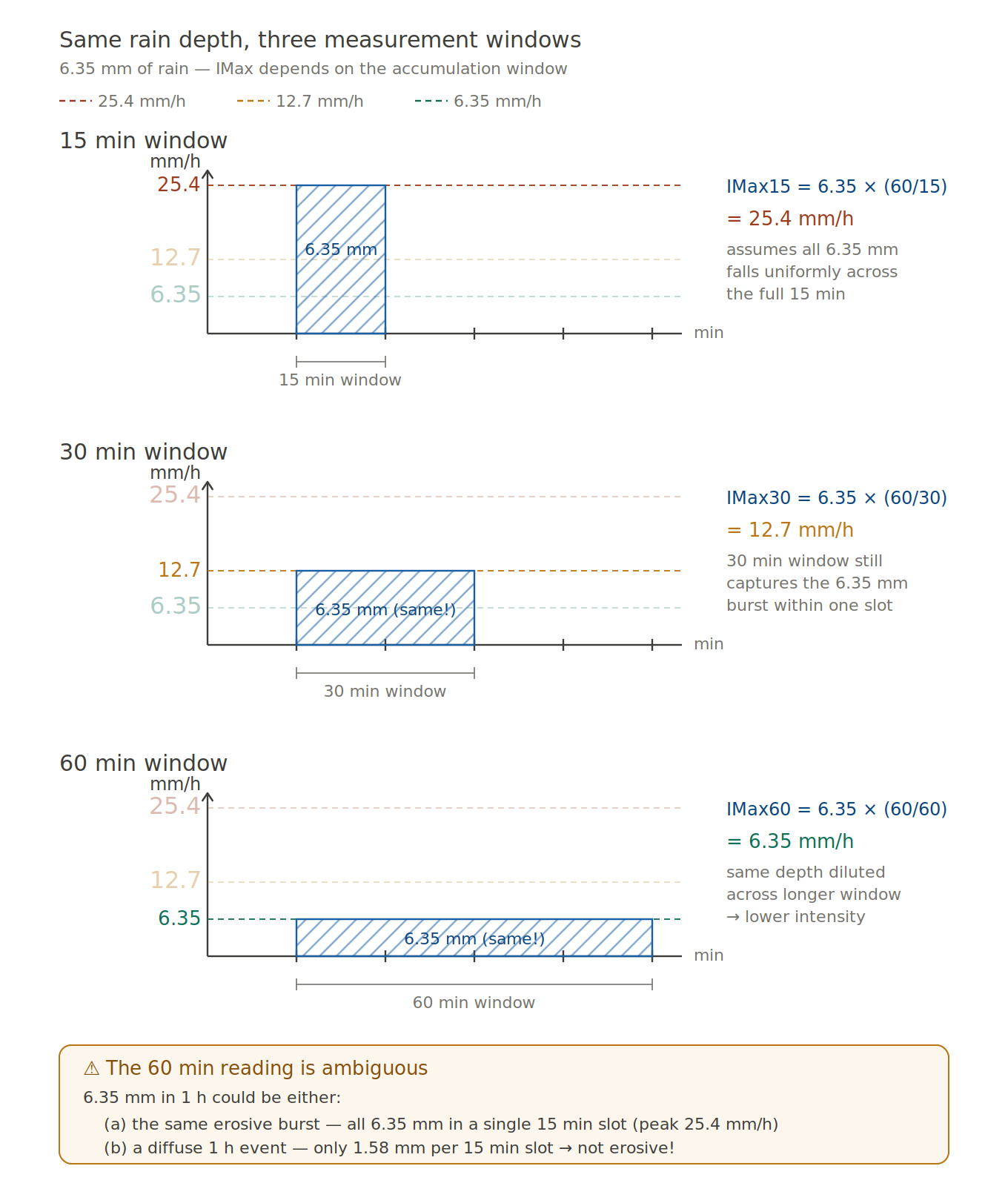
| Standard RUSLE | event_depth ≥ 12.7 mm | IMax15 ≥ 25.4 mm/h | Wischmeier & Smith (1978); 6.35 mm in 15 min |
| Alternative | event_depth ≥ 12.7 mm | IMax30 ≥ 12.7 mm/h | Wider window; looser filter; validated vs RIST |
Both thresholds derive from the same physical quantity — 6.35 mm concentrated within the accumulation window. The wider 30-min window selects more events than IMax15 on identical data.
Kinetic Energy Formulas
get_events_values() accepts a formula argument. All formulas are normalized to [kJ m⁻² mm⁻¹]:
| Key | Formula | Reference | Notes |
|---|---|---|---|
'rogler' (default) |
e_k = (11.89 + 8.73·log₁₀I) × 10⁻³, capped at 28.33×10⁻³ for I ≥ 76.2 mm/h | Rogler & Schwertmann (1981) / DIN 19708 | European calibration, log form |
'brown_foster' |
e_k = 0.029·(1 − 0.72·exp(−0.05I)) | Brown & Foster (1987), RUSLE standard | Exponential form, natural plateau |
'mcgregor' |
e_k = 0.029·(1 − 0.72·exp(−0.082I)) | McGregor et al. (1995), RUSLE2 | Steeper decay at low intensities |
Key Functions
| Function | Description |
|---|---|
| Core pipeline | |
remove_incomplete_years() | Removes years with >10% missing data; auto-detects time resolution |
get_events() | Extracts events using a minimum dry-spell gap (default 6 h); removes events near data gaps |
remove_short() | Filters events shorter than a minimum duration |
get_events_values() | Computes depth, E_kin, and imax_5/10/15/30/60 for each event; supports formula choice |
compute_erosivity() | Adds erosivity_EU and erosivity_US (EI30 = E_kin × IMax30/60); auto-detects imax column |
get_only_erosivity_events() | Dual-criterion filter: IMax ≥ threshold OR depth ≥ 12.7 mm |
apply_rusle_split() | Renard (1997) within-storm splitting: splits where any 6 h window < 1.27 mm, then re-filters |
| Resolution correction | |
find_optimal_thr_imax30() | Finds the intensity threshold that minimises the gap in mean annual event count to a reference (Fischer et al. 2018) |
compute_sf_annual_r() | Scaling factor from year-by-year annual R comparison (same calendar period required) |
compute_sf_clim() | Scaling factor from climatological mean annual R; no year matching — for obs vs CPM |
compute_sf_per_event() | Scaling factor from matched per-event EI (inner join on event date) |
| Statistics & uncertainty | |
get_mean_annual_stats() | Mean annual event count, R-factor, depth, and intensity from an event table |
bootstrapping_erosivity_60min() | Block bootstrap over calendar years for observational data |
bootstrapping_erosivity_CPM_60min() | Bootstrap with optional pre-defined year-draw sequence (for CPM ensemble comparisons) |
| Kinetic energy (unit functions) | |
E_kin_i_Rogler() | Rogler & Schwertmann (1981) / DIN 19708 — default |
E_kin_i_BrFr() | Brown & Foster (1987) — RUSLE standard |
E_kin_i_McGregor() | McGregor et al. (1995) — RUSLE2 variant |
Study 1: Validation against RIST 3.99
pyErosivity was validated against RIST 3.99 (USDA Rainfall Intensity Summarization Tool) — the reference implementation of RUSLE — using 31 years (1990–2020) of 5-min data from station VE_0091 near Kreuzbergpass, Italy (~1600 m a.s.l.).
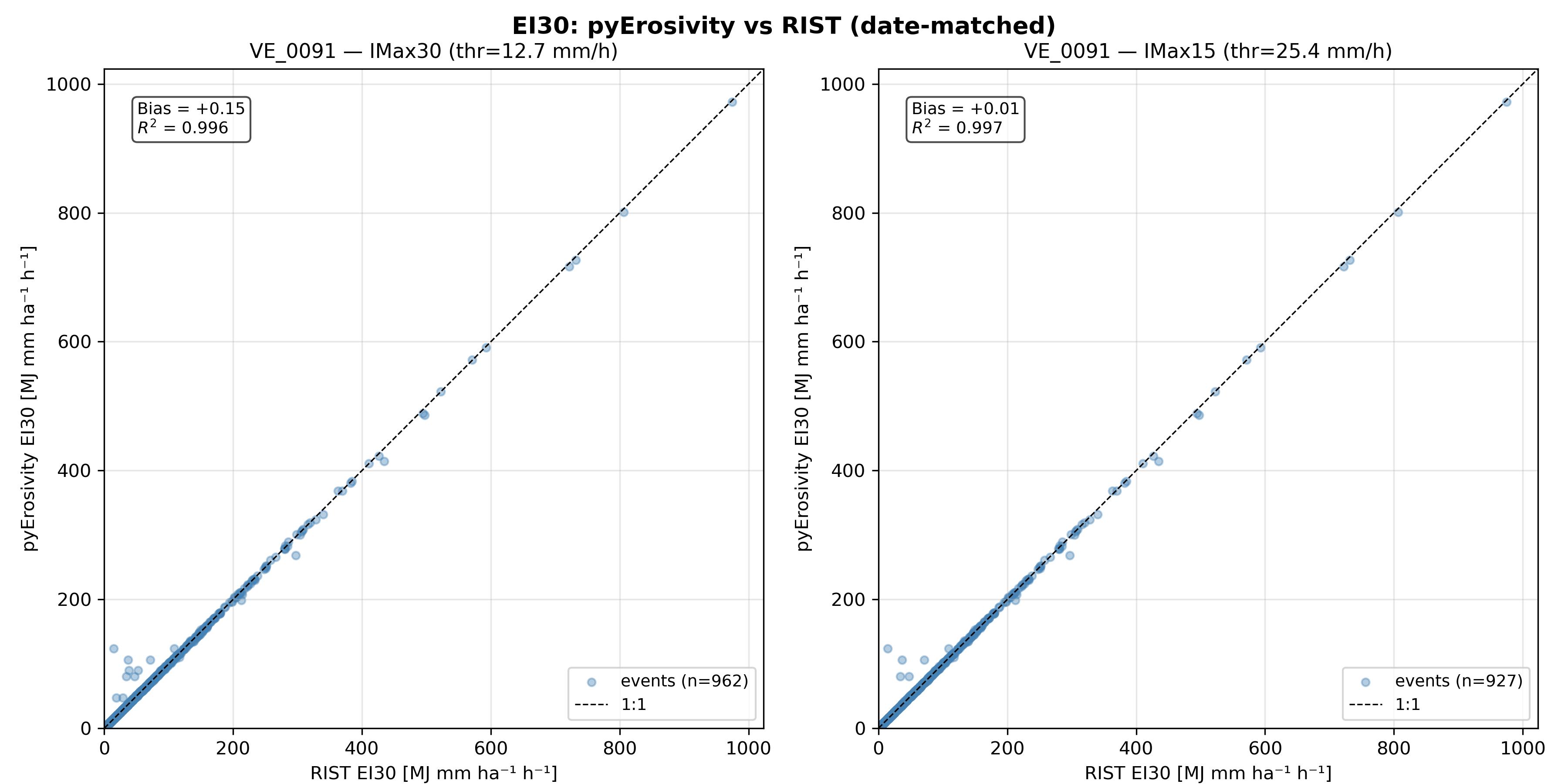
| RIST IMax30 | pyEr IMax30 | RIST IMax15 | pyEr IMax15 | |
|---|---|---|---|---|
| Events (total) | 962 | 966 | 927 | 931 |
| Events / yr | 31.0 | 31.2 | 29.9 | 30.0 |
| Mean depth [mm] | 31.4 | 31.5 | 32.3 | 32.3 |
| R-factor [MJ mm ha⁻¹ h⁻¹ yr⁻¹] | 2027.8 | 2019.7 | 1993.0 | 1985.6 |
Study 2: Effect of Temporal Resolution
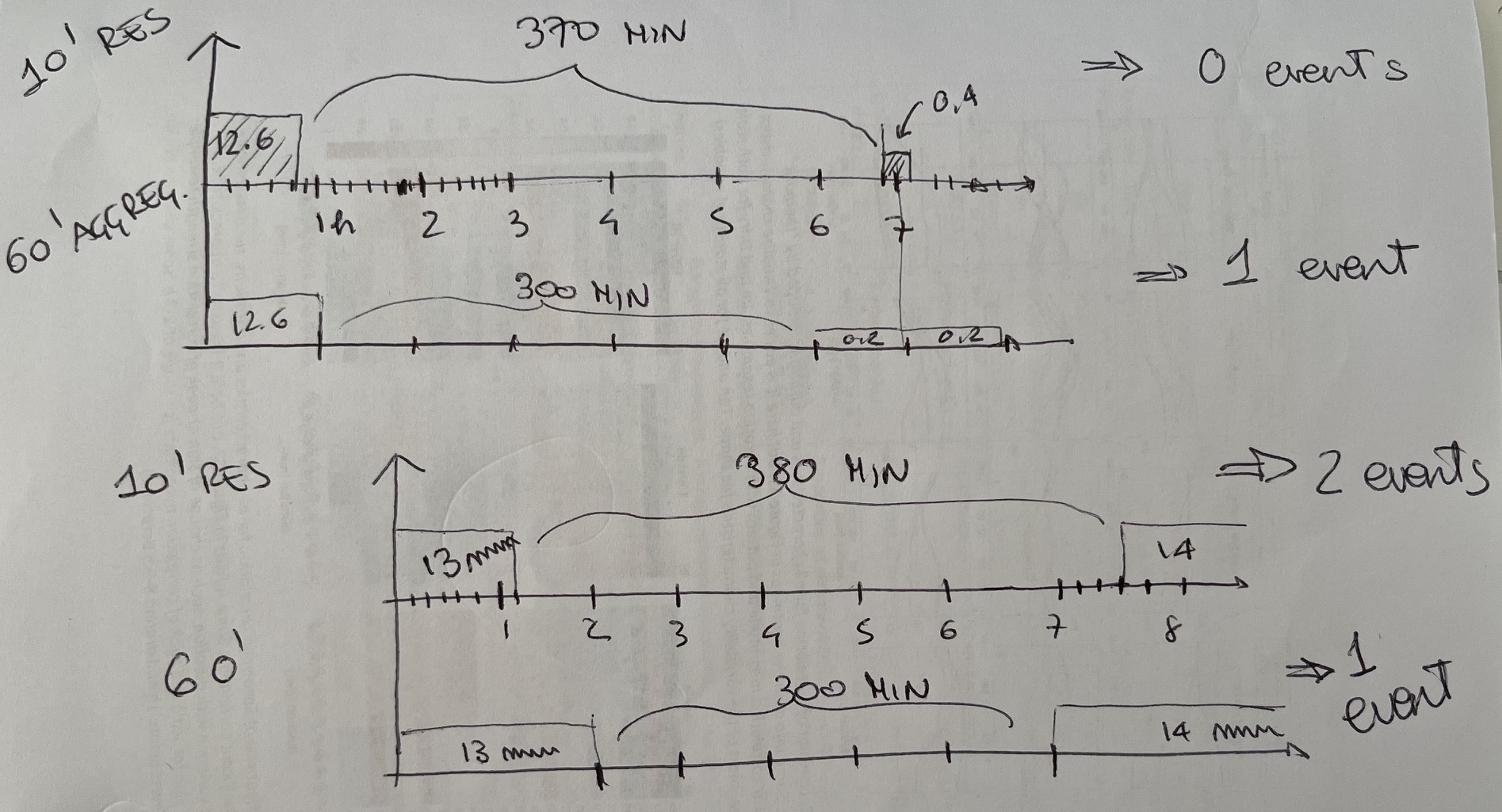
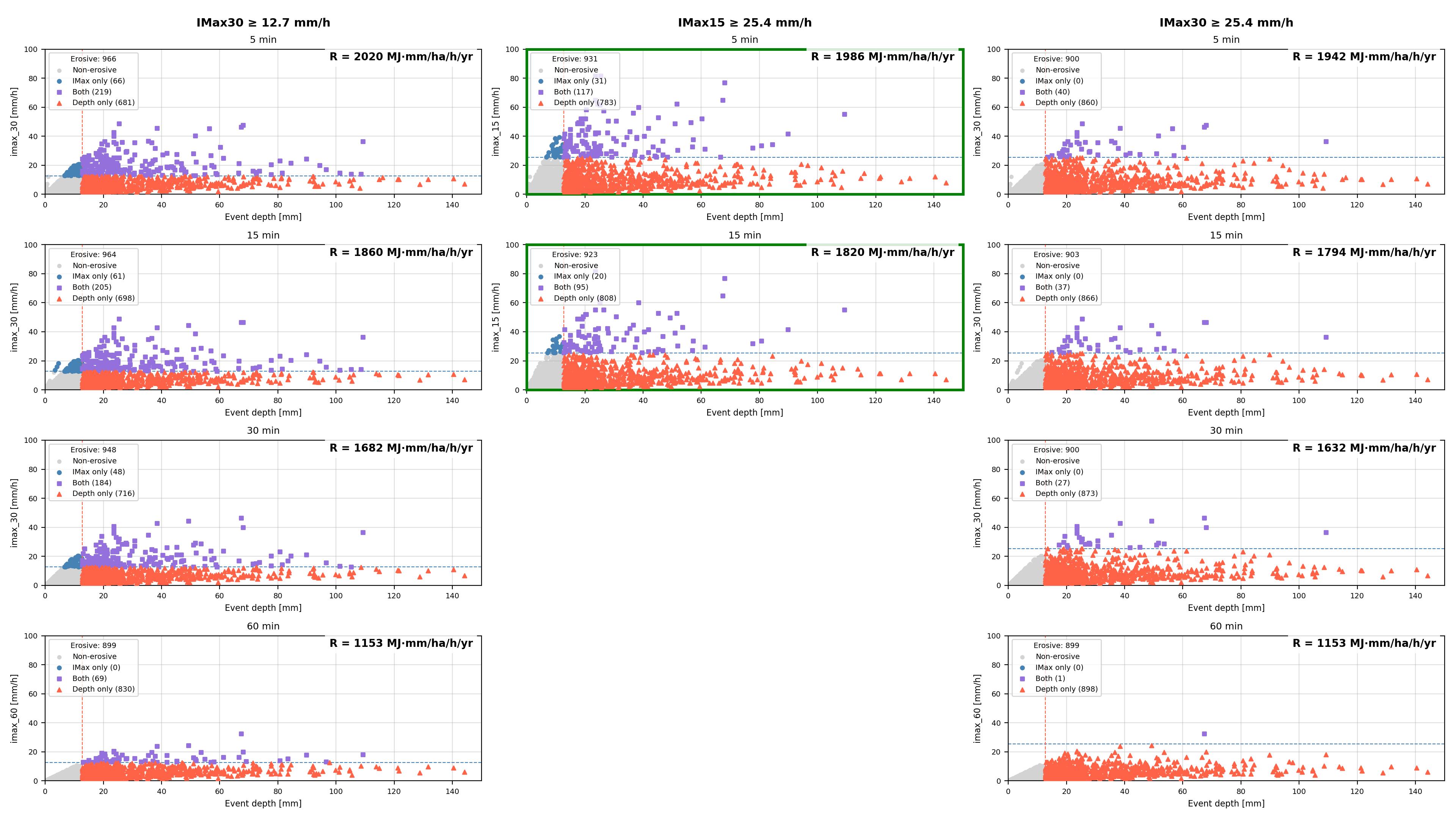
At coarser temporal resolution (15, 30, 60 min), IMax30 is underestimated because the sliding window straddles fixed clock bins. Two distinct problems arise:
At 60-min resolution the IMax-only zone empties completely for any threshold: an event intense enough to exceed 12.7 mm/h in one hour automatically accumulates ≥ 12.7 mm and satisfies the depth criterion instead. The R-factor drops by ~43% relative to 5-min.
Study 3: Threshold Calibration & Scaling Factor Correction
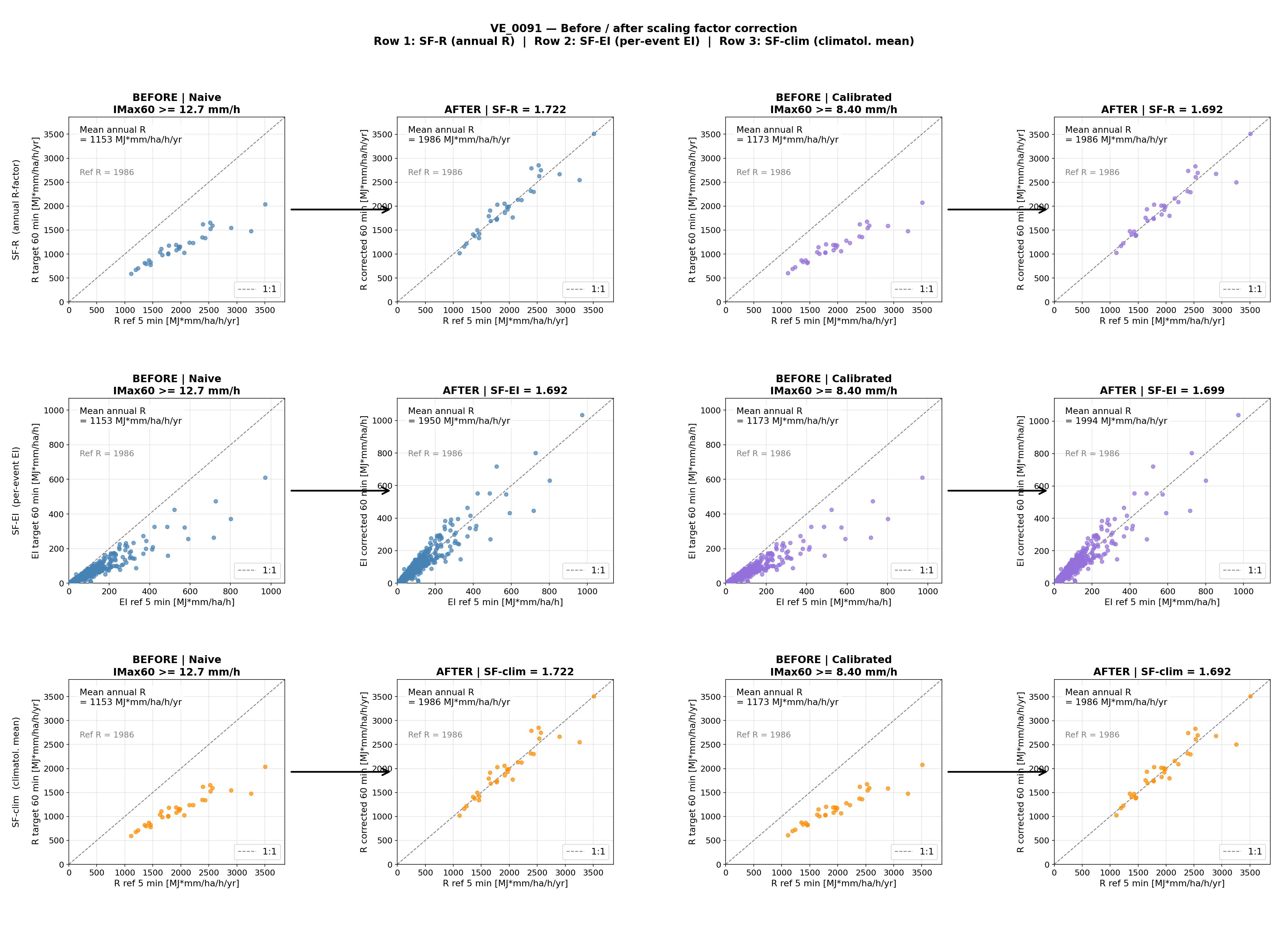
Coarser resolution introduces two independent biases: (1) event selection bias — the intensity criterion selects fewer events; (2) intensity underestimation bias — EI30 is lower even for the same storm. Two correction steps address them:
- Threshold calibration:
find_optimal_thr_imax30()sweeps all unique IMax values and finds the cut-off that recovers the 5-min event count. For 60-min data the optimal threshold is ~6.8 mm/h (vs the naive 12.7 mm/h). - Scaling factor: a multiplicative SF removes the remaining within-event intensity bias. Three approaches are available —
compute_sf_annual_r(year-by-year),compute_sf_per_event(matched events), andcompute_sf_clim(climatological mean; required when obs and CPM cover different periods).
Study 4: Bootstrap Uncertainty & OBS vs CPM Comparison
bootstrapping_erosivity_60min() and bootstrapping_erosivity_CPM_60min() estimate uncertainty by block-resampling calendar years (default 1000 iterations). The CPM variant accepts a pre-defined year-draw array (randy) so that different ensemble members are compared on identical samples.
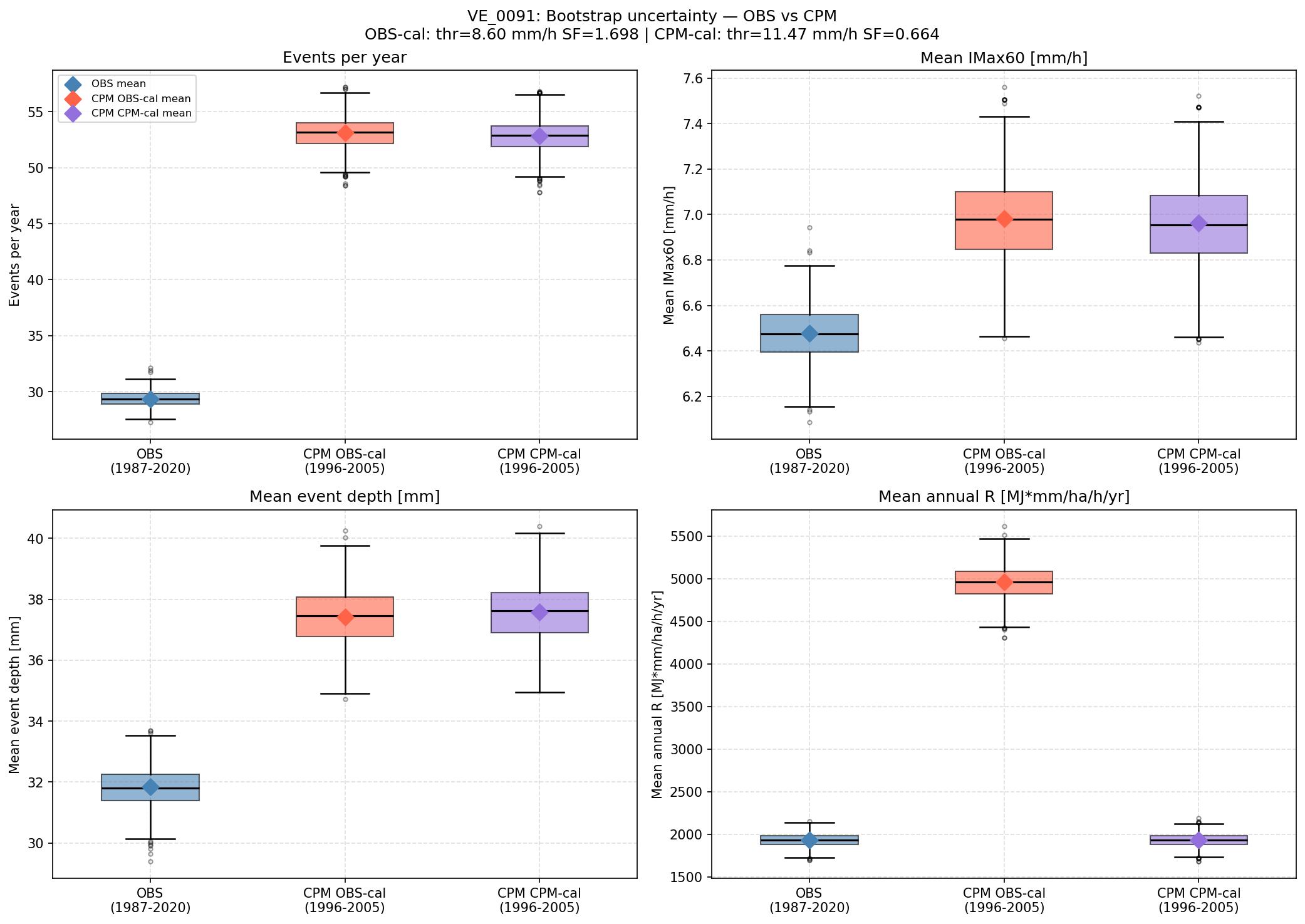
The comparison highlights that threshold calibration and scaling factor correction address temporal resolution bias but do not replace a full bias correction of the underlying precipitation field. The CPM's ~95% wet bias at this Alpine station propagates directly into erosive event counts and R-factor even after resolution correction.
References
Wischmeier, W. H. & Smith, D. D. (1978).
Predicting Rainfall Erosion Losses. USDA Agricultural Handbook 537.
Renard, K. G. et al. (1997).
Predicting Soil Erosion by Water (RUSLE). USDA Agricultural Handbook 703.
Rogler, H. & Schwertmann, U. (1981).
Erosivität der Niederschläge und Isoerodentkarte Bayerns.
Journal of Rural Engineering and Development, 22, 99–112.
Fischer, F. K., Winterrath, T. & Auerswald, K. (2018).
Temporal- and spatial-scale and positional effects on rain erosivity.
Hydrology and Earth System Sciences, 22, 6505–6518.
https://doi.org/10.5194/hess-22-6505-2018
Brown, L. C. & Foster, G. R. (1987).
Storm erosivity using idealized intensity distributions.
Transactions of the ASAE, 30(2), 379–386.
van Dijk, A. I. J. M., Bruijnzeel, L. A. & Rosewell, C. J. (2002).
Rainfall intensity–kinetic energy relationships: a critical literature appraisal.
Journal of Hydrology, 261(1), 1–23.
https://doi.org/10.1016/S0022-1694(02)00020-3